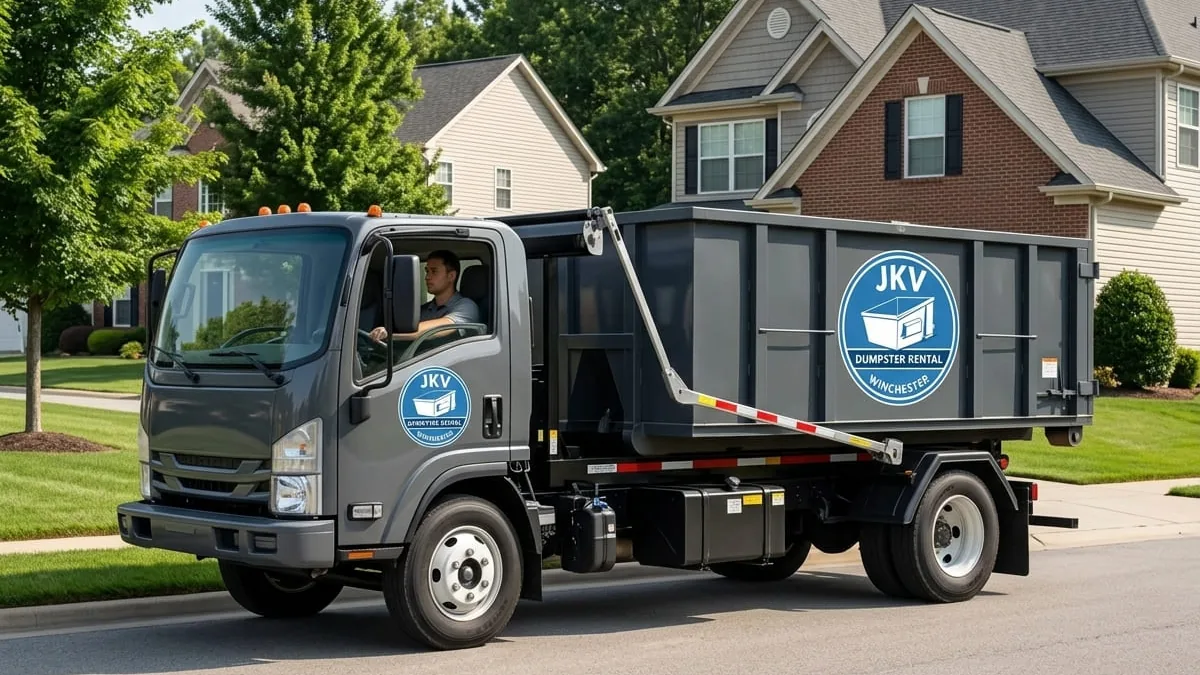
This is one of the first questions we get from customers who have never rented a roll-off dumpster before, and it's a fair one — nobody wants a surprise ticket or a delayed delivery over paperwork they didn't know they needed. The short answer is that it depends almost entirely on where the container sits, not on the job itself. A dumpster parked on your own driveway is treated very differently than one that has to sit in the street.
On Your Own Driveway or Property: Generally No Permit
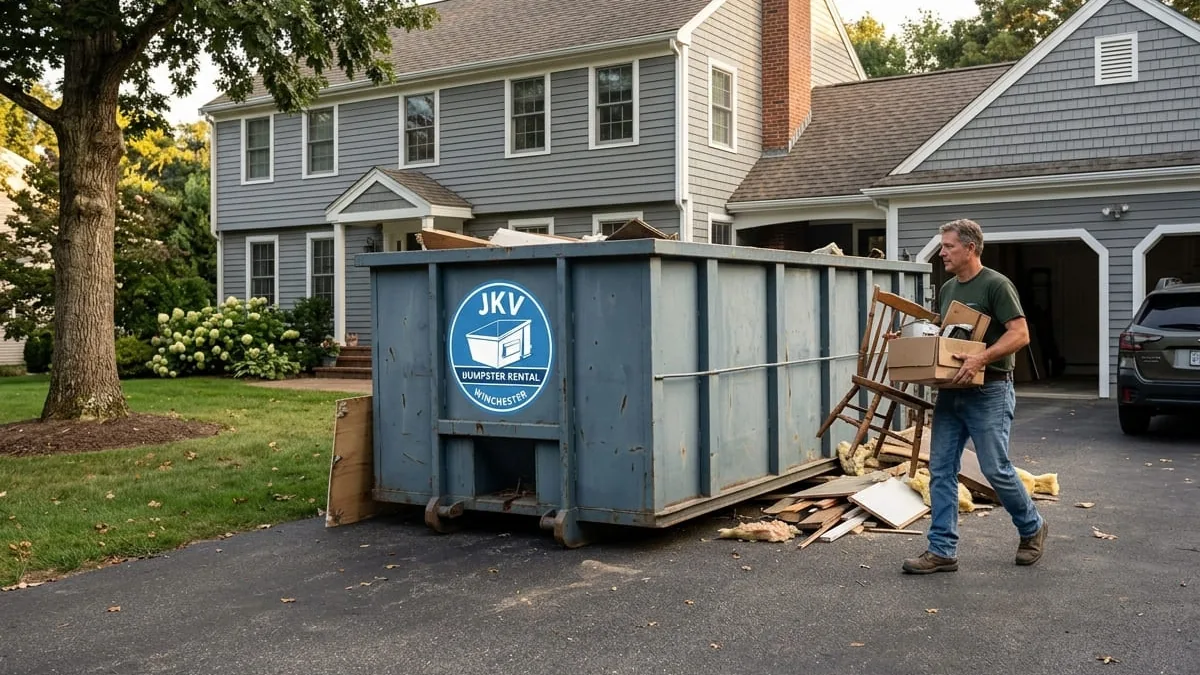
If we're dropping your container on your driveway, in your yard, or anywhere else on your own private property in Winchester or Frederick County, you generally do not need a permit. This covers the large majority of the residential and small commercial jobs we do — a residential cleanout, a remodel, a garage purge, a roof tear-off with the container staged in the driveway. As long as the dumpster stays on land you own or control and isn't blocking a public sidewalk or street, the City doesn't require any paperwork on your end for that placement.
That said, "generally" is doing some work in that sentence. A few things are still worth checking before delivery day:
- Make sure the spot is level and stable — more on why that matters below.
- Confirm the container won't overhang a sidewalk, block a fire hydrant, or obstruct a neighbor's driveway.
- If your property has a shared or private easement driveway, check that placement doesn't block access for anyone else who uses it.
None of that requires a permit application — it's just common sense that keeps delivery day simple and avoids a container that has to be moved after the fact.
In the Street or Public Right-of-Way: You Need a Right-of-Way Work Permit
The situation changes as soon as a dumpster has to sit in the street, on a public shoulder, or anywhere else within the public right-of-way — which happens most often on tight urban lots in and around Old Town Winchester where there's no driveway long enough or wide enough to hold a roll-off container. In that case, the City of Winchester requires a Right-of-Way Work Permit from the Public Services Department before the container can be placed.
Here's what that means in practice:
- The permit is issued by the City's Public Services Department, and you can reach their office at (540) 667-1815 with questions about the application or process.
- There is a fee associated with the permit — the City maintains its own fee schedule for right-of-way work, so we'd rather point you to them directly for the current amount than guess at a number here.
- Applications and general permitting information are handled through the City's Permits, Licensing & Applications page, linked below.
The single biggest mistake we see with street placement is timing. A driveway drop can often happen same-day or next-day — see our same-day dumpster rental page for how that works. A street placement cannot move that fast, because the permit has to be approved first. If your project depends on a container sitting in the street, get the permit conversation started with the City well before your target delivery date, not the morning of. We're glad to help you figure out ahead of time whether your specific spot will need one, but the application itself goes through the City, not through us.
For full details and current forms, visit the City of Winchester Permits, Licensing & Applications page.
HOA Rules Are a Separate Question From Permits
A municipal permit and a homeowners association rule are two completely different things, and it's easy to assume that clearing one means you've cleared both. Even when a dumpster sits entirely on your own driveway and needs no City permit at all, your HOA may still have its own restrictions — a maximum number of days a container can be on-site, a requirement that it not be visible from the street, or a notice-to-the-board rule before delivery. None of that is enforced by the City, and none of it shows up in any government permit database. If you're in a neighborhood with an HOA, it's worth a quick look at your covenants or a call to your property manager before you book, especially for a job that might run past the standard rental period.
Frederick, Clarke, and Warren Counties Can Differ From the City
Everything above describes the City of Winchester specifically, since Winchester is an independent city with its own government, separate from surrounding Frederick County. Most of our jobs are in Winchester itself or in unincorporated parts of Frederick County, and we also work occasionally in Clarke County and, less often, out toward Front Royal in Warren County. Unincorporated areas of these counties are not automatically covered by the City's right-of-way rules, and each county sets its own policy for its own roads. If your job is outside the Winchester city limits, the safest move is a quick call to the specific county or town where the work is happening to confirm whether any local rule applies to your situation. We serve a wide range of towns across this area — you can see the full list on our service area page — and we're happy to share what we've seen in a given town, but the county or municipality is always the authority on its own permitting.
Why Where the Dumpster Sits Matters Beyond Permits
One more placement note that's worth mentioning here, separate from permits: the Winchester and Frederick County area sits on a well-documented limestone karst belt that runs through the northern Shenandoah Valley. That geology means shallow bedrock and occasionally softer or uneven ground in spots, even on land that looks perfectly flat. It's part of why we always recommend placing a loaded roll-off — which can weigh several tons — on level, stable ground, away from any low spot or depression, rather than assuming any patch of the yard will do. This has nothing to do with permits, but it's exactly the kind of thing worth mentioning while you're planning where the container will go.
How JKV Handles This
When you call us at (540) 546-5055 to book a construction dumpster rental or any other job, we'll ask where you're planning to place the container as a normal part of scheduling. If it sounds like a street placement, we'll flag that early so you have time to reach out to the City's Public Services Department before your delivery date instead of finding out the day of. For driveway placements, we handle it the same way we always do — no permit needed on your end, and we bring boards to protect the surface underneath.